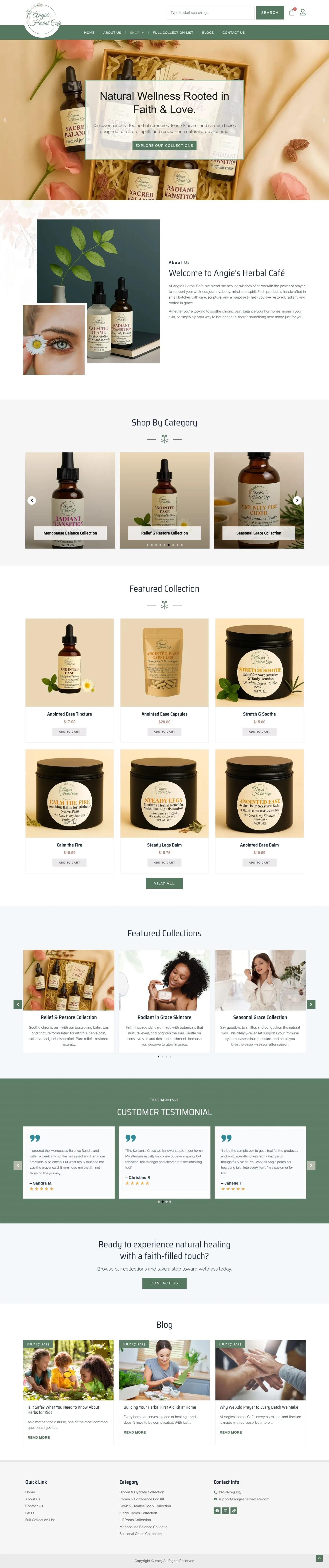
This maker sells tinctures, capsules, balms, teas, soaps and sample boxes. Sorted by product type that is an incoherent list. Sorted into seven named collections it becomes a range a customer can navigate, and the store is built that way from the category structure up.
Results at a Glance
A catalogue of balms, tinctures, capsules, soaps and teas has no natural order. A customer arriving with a specific need does not want to scroll a mixed grid of formats, and a customer arriving to browse has nothing to hold on to.
Seven collections give both of them a route. The collection is the primary axis of the store, the product format is secondary, and the full collection list sits in the main navigation rather than behind a filter nobody opens.
Small-batch makers add products constantly and rarely in a tidy pattern. The store had to absorb a new product into an existing collection without anyone rebuilding a menu, while keeping the sample box, which cuts across every collection, from breaking the structure.
Mixed formats do not sort themselves
Balms, teas, capsules and soaps in one grid give a customer nothing to navigate by.
New products arrive constantly
A structure that needs editing every time a batch launches will not survive the year.
Sample boxes cut across everything
A product that belongs to no single collection has to fit without breaking the model.
Articles and products both matter
Customers search for a symptom or an ingredient, not always for a product name.
The challenge was real, and it was costing time, money, and client experience.
Collections are real taxonomy rather than tags bolted on afterwards, so a new product joins one and appears everywhere that collection is surfaced. The navigation carries a full collection list as its own destination, which is what a returning customer actually uses.
Product pages, cart and checkout are standard WooCommerce with the theme styled around them rather than replaced, so payment, tax and stock behaviour stay on paths that keep working through updates. The blog runs on the same content model, and search covers products and articles together.
The solution was designed from the ground up to fit this exact business.
Seven collections as real taxonomy, not tags added after launch.
A dedicated collection list in the main navigation, not a hidden filter.
WooCommerce cart and checkout styled, never replaced.
One search covering products and articles together.
Each tool chosen specifically for reliability, integration depth, and ease of use for the client.
Content, blog and collection structure.
Products, cart, checkout and tax.
Seven collections as the primary axis.
Products and articles in one result set.
A store organised the way the brand actually thinks about its range.
The primary way in, carried in the main navigation.
A new product joins a collection and appears everywhere it is surfaced.
Payment and tax left on standard paths that survive updates.
Send me the brief, a Figma file, a reference site or a rough outline, and you'll have a fixed quote with a delivery date within 24 hours.