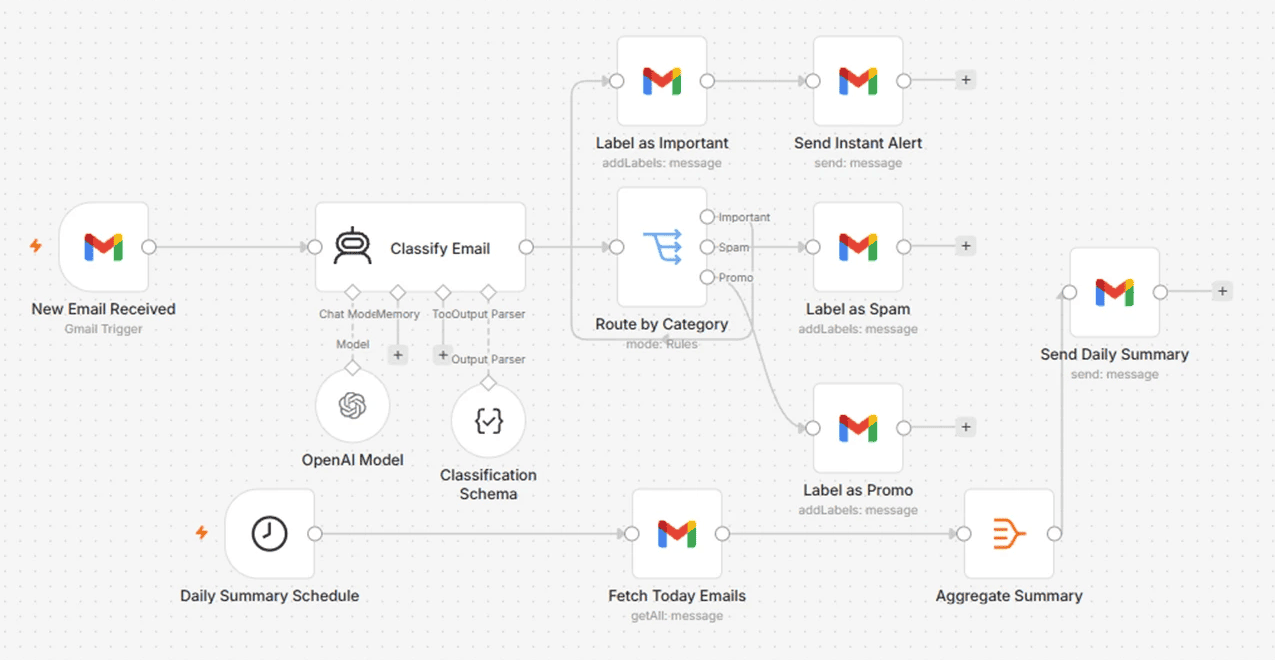
Every incoming email is classified against a fixed schema, labelled in Gmail and routed. Important mail raises an instant alert. Everything else waits for a scheduled daily summary, so the inbox stops interrupting.
Results at a Glance
Most inbox tools sort mail into folders and leave you to check them. That solves tidiness and not attention, because the checking still has to happen.
This one splits the two: anything important escalates immediately, and everything else is held and delivered as a single summary at a set time.
A classifier that returns free text is unusable in a workflow, because the next node cannot branch on a sentence. The classification had to come back in a fixed shape every time, and the routing had to be explicit about what happens to each category.
Sorting does not stop interruption
Folders still have to be checked. Splitting urgent from everything else is what actually buys back attention.
Free-text answers cannot be routed
A workflow needs a fixed set of values to branch on, which means a schema and a structured parser rather than a prompt alone.
Misfiled important mail is expensive
The cost of a wrong classification is asymmetric, so important mail escalates rather than waiting for the digest.
A digest needs its own trigger
The summary runs on a schedule, independent of whether any mail arrived.
The challenge was real, and it was costing time, money, and client experience.
A Gmail trigger passes each message to a classification step running on an OpenAI model with a structured output parser and a defined schema, so the result is always one of a known set of categories rather than prose.
A rules node then routes on that category: important mail is labelled and raises an instant alert, spam and promotional mail are labelled and left. A second scheduled branch collects the day’s mail, aggregates it and sends one summary.
The solution was designed from the ground up to fit this exact business.
A Gmail trigger passes each message to a model constrained by a classification schema.
A rules node sends important, spam and promotional mail down separate paths.
Important mail is labelled and raises an alert immediately.
A scheduled branch fetches the day’s mail, aggregates it and sends one summary.
Each tool chosen specifically for reliability, integration depth, and ease of use for the client.
Classification, routing and the scheduled digest.
Classification against a fixed schema.
Trigger, labelling and delivery.
Urgent mail interrupts. Nothing else does.
A fixed output shape, so routing can branch reliably.
Important mail escalates the moment it lands.
Everything else arrives once, at a set time.
Send me the brief, a Figma file, a reference site or a rough outline, and you'll have a fixed quote with a delivery date within 24 hours.