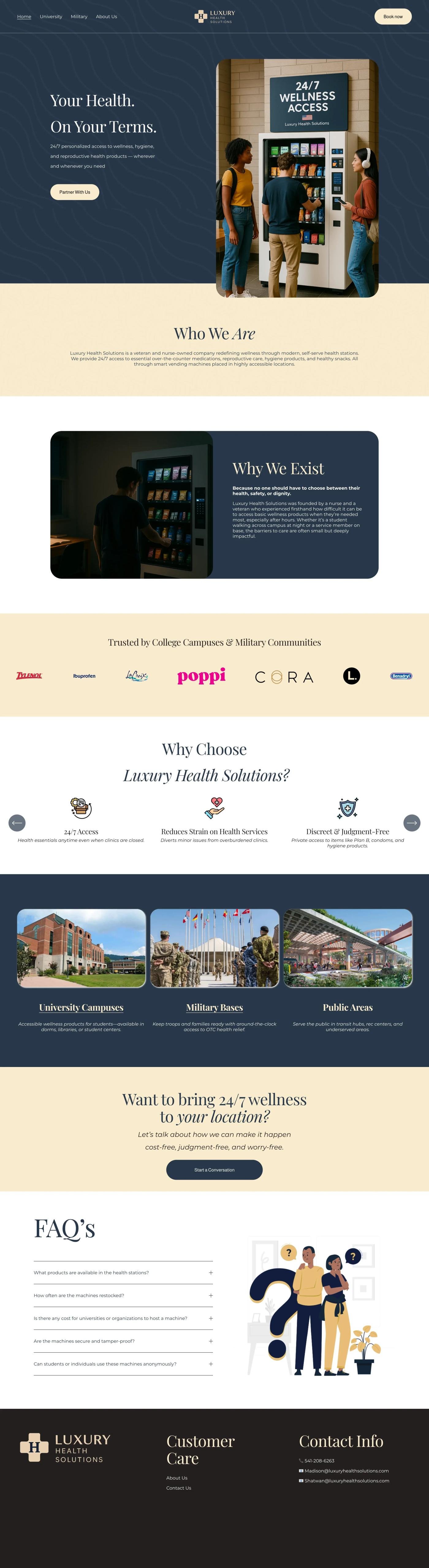
The people using these machines are not the customer. The customer is the facilities manager deciding whether to host one. That single fact reorganises the entire site: every section answers a hosting question, and the only call to action is a partnership conversation.
Results at a Glance
A consumer-facing build would lead with products and convenience. It would also fail, because the person who reads it cannot buy anything: they can only agree to place a machine in their building.
So the site is written for the host. Each of the three placement environments gets its own framing, and the questions that decide the deal, cost to the host, security, restocking and user anonymity, are answered on the page rather than left to a sales call.
Three very different host types with different concerns: a university worrying about student welfare and liability, a base worrying about readiness and access, and a public operator worrying about footfall and maintenance. One site, three sets of objections, and a category where discretion matters to the end user.
The reader cannot buy the product
A consumer-facing page speaks to the wrong person entirely.
Three host types, three worries
Campuses, bases and public operators each object for different reasons.
Cost is the first question
A host will not enquire until they know what it costs them to say yes.
Discretion is the product
For this category, privacy has to be stated rather than implied.
The challenge was real, and it was costing time, money, and client experience.
The three environments are presented as parallel segments with their own imagery and their own one-line case, so a reader identifies theirs immediately without the site splitting into three funnels. The navigation carries two of them as top-level destinations because they are the priority channels.
The FAQ is built from host objections rather than user questions, and it is placed before the final call to action so that the remaining doubts are gone by the time the button appears. Discretion is stated plainly as a product property rather than implied, because for this category it is the thing that makes a host say yes.
The solution was designed from the ground up to fit this exact business.
Every section answers a placement question, not a shopping one.
Three environments in parallel, each with its own one-line case.
Cost, security, restocking and anonymity answered before the CTA.
Every segment ends at the same conversation.
Each tool chosen specifically for reliability, integration depth, and ease of use for the client.
Segment pages, FAQ and partnership flow.
Three host environments in one structure.
Host questions placed before the call to action.
A single conversation as the only outcome.
A B2B site for a product the buyer will never personally use.
Written for the person who places the machine, not the person who uses it.
Campus, base and public, each identified in one line.
The deal-deciding questions handled before the button appears.
Send me the brief, a Figma file, a reference site or a rough outline, and you'll have a fixed quote with a delivery date within 24 hours.
