Customers ask questions on WhatsApp in whatever form is easiest: a typed message, a voice note, a photograph of a problem, or a PDF. This agent accepts all four, converts each into text, and answers from the client’s own documentation rather than from general knowledge.
Results at a Glance
People do not write neat questions on WhatsApp. They record a voice note while walking, photograph the thing that is wrong, or forward a document and ask what it means. A bot that only reads typed text ignores a large share of what actually arrives.
So the workflow branches on message type before it thinks about answering. Audio is transcribed, images are described, documents are parsed, and only then does everything meet the same knowledge agent as plain text.
Two problems at once. The first is media: four different input formats, each needing its own download and conversion path before it becomes something a language model can use. The second is accuracy: a support bot that invents answers is worse than no bot, so it had to answer from the client’s documents rather than from whatever the model already believed.
Voice notes are the default
A large share of WhatsApp questions arrive as audio. Ignoring them means ignoring the customers who are in the biggest hurry.
Attachments are not one format
PDF, XLS and XLSX each need a different extractor, and an unsupported file has to be answered rather than dropped.
A bot that guesses is worse than none
Answers had to come from the client’s documentation, not from the model’s general knowledge.
The knowledge has to stay current
If updating it needed a developer, it would go stale within a month.
The challenge was real, and it was costing time, money, and client experience.
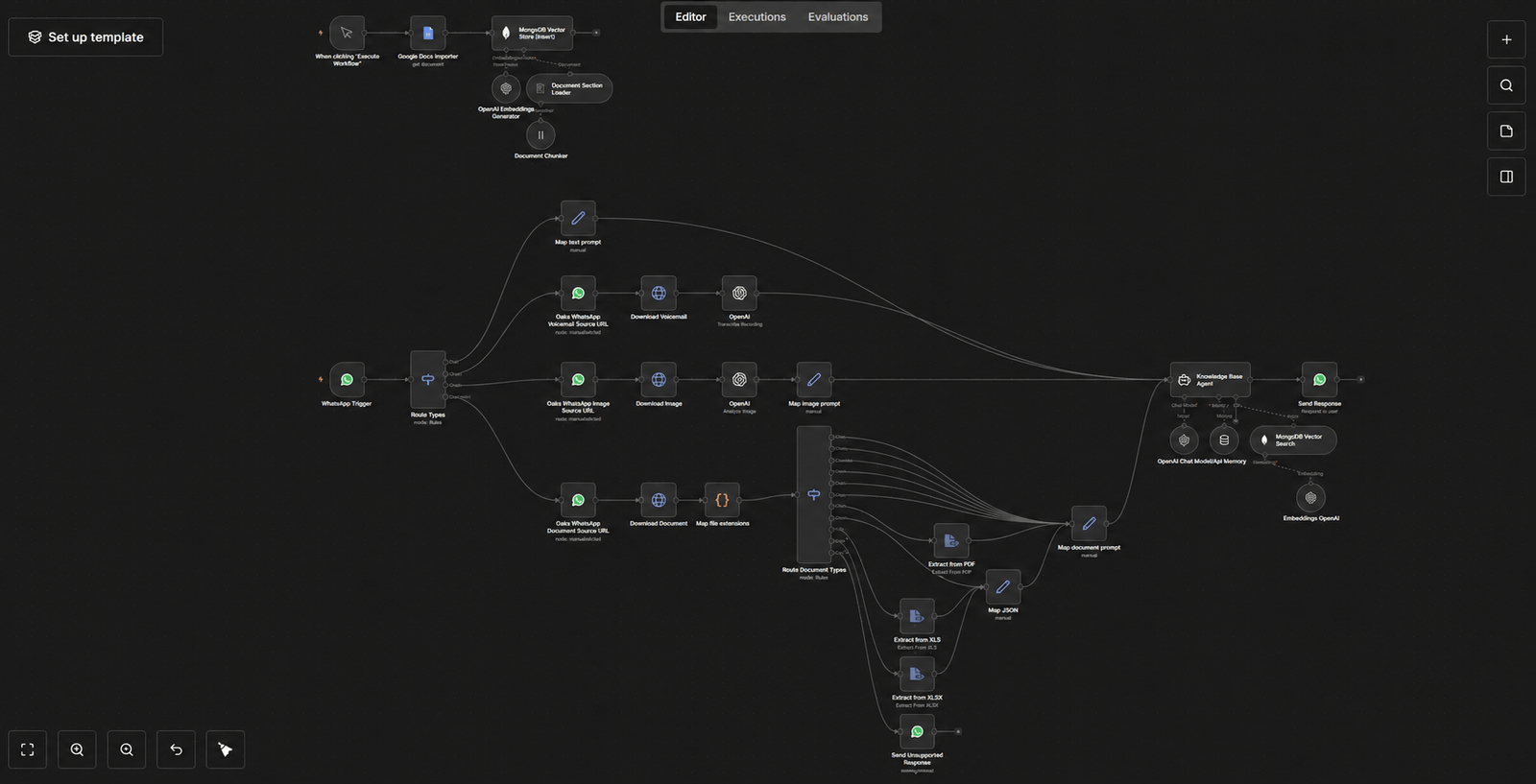
The WhatsApp trigger feeds a rules-based router that splits the message four ways. Text passes straight through. Voice notes are downloaded and transcribed. Images are downloaded and described. Documents go through a second router that picks the right extractor for PDF, XLS or XLSX, and returns a clear message rather than failing silently when the format is not supported.
All four branches converge on one knowledge agent. Its answers are grounded in a MongoDB vector store built by a separate ingestion pipeline: Google Docs come in, get split into sections, are chunked, embedded and stored. Updating the knowledge base is a document edit, not a developer task.
The solution was designed from the ground up to fit this exact business.
A rules node splits the WhatsApp trigger four ways before anything else happens.
Voice notes transcribed, images described, documents parsed by format-specific extractors.
A separate pipeline chunks and embeds the client’s documents into a MongoDB vector store.
One agent retrieves from the vector store and replies on the same WhatsApp thread.
Each tool chosen specifically for reliability, integration depth, and ease of use for the client.
Routing, media handling and orchestration.
Transcription, image description and answers.
Vector store for the knowledge base.
The channel customers already use.
One agent, four kinds of question, answering from the client’s own material.
Text, voice note, image and document, all on one thread.
PDF, XLS and XLSX, with a clear reply when a format is not supported.
Editing a Google Doc updates the knowledge base.
Send me the brief, a Figma file, a reference site or a rough outline, and you'll have a fixed quote with a delivery date within 24 hours.